

I woke up in the middle of the night startled. I was in a cold sweat. It was our first night in Munich at The Hotel Opéra, and I woke up my husband and said we need to leave. I’m scared. I don’t like it here. I thought for certain the Nazis were going to knock down our hotel door and take both of us away. It felt real. I panicked and this feeling stayed with me for our entire time in Germany. Then we went on to the Czech Republic and Austria, and these feelings were present but not as strong. Since returning home to the US, I have had two more nights of waking up in a panic.
I’m Jewish. I lost family to the Holocaust and the pograms of Russia and Austria. I was not at all expecting this visceral reaction. I know atrocities happened throughout Europe, but for some reason this feeling was strongest in Germany. Maybe it is because Nazism started in Munich or atrocities of some kind happened in our Munich hotel room a long time ago. Or it is simply the memories of my ancestors are imprinted on my soul. Is is my DNA.
I do know we were considering staying at the Torbrau Hotel, which is the oldest hotel in Munich. It was in the basement of this property that the infamous SS was founded by Hitler in 1925. There is, of course, no mention of any of this history on their website. One has to carefully search on the internet to find this piece of information. I am so glad my husband found this out prior to our stay. I can’t imagine my feelings if I stayed at that property.
Down the street from the old town hall building of Munich, near our hotel, Hitler’s Minister of Propaganda Joseph Goebbels ordered Kristallnacht, the night of broken glass. Jewish property, businesses and synagogues were destroyed throughout Germany and Austria in November, 1938.
I tried to push these feelings to the back of my consciousness as we visited the city. A walk through The Hofgarten and The Munich Residenz were wonderful, as well as visits to The Nymphenburg Palace and Park.
The Jewish Museum was a disappointment as the exhibits were more secular in nature. The city itself does have a fairly new Holocaust remembrance system that has vertically-displayed plagues that pay tribute to victims of the Nazi regime. These plagues or memorial markers will join existing commemorative brass cobblestones, known as ‘stolpersteine’ or ‘stumbling stones’, whose controversial placement in the ground has led to the development of this new memorial system in Munich. Across Germany and Europe there are more than 60,000 ‘stumbling stone’ memorials.


This profound experience in Munich palled in comparison to the feelings I experienced while visiting Dachau. I had visited the Holocaust Memorial in Washington DC and Yad Vashem in Israel. Both were gut wrenching. However, nothing prepares you for the overwhelming and profound experience you feel walking through the place of horror: hate, evil and murder.
From central Munich we took a train straight to the town of Dachau, where we then took a short bus ride to the concentration death camp. The concentration death camp of Dachau lies only 10 miles northwest of Munich. It was one of the first concentration camps in Nazi Germany and would serve as a model for all other camps in the Third Reich.
We followed the “path of the prisoner”, walking the same way prisoners were forced to after their arrival at the camp. We saw a rebuilt barrack, and barrack X which includes the showers and the crematorium. We cried at the umarked graves and various memorials.
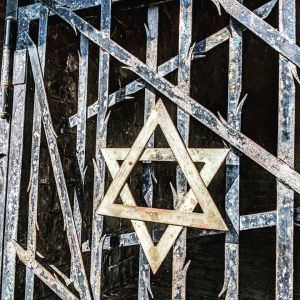
Dachau was a death camp. From the moment we walked through the gates where “arbeit macht frei” was etched in the metal, tears began to fall. This means “work sets you free” and the prisoners who worked outside of the camp saw this everyday. It was a heart wrenching experience and I cried throughout much of time at Dachau.
I could only take a few pictures. The experience was overwhelming.
The residual effect will stay with me forever. It has imprinted on my heart and soul.
#neveragain
#neverforget
 Who Stole My Estrogen?